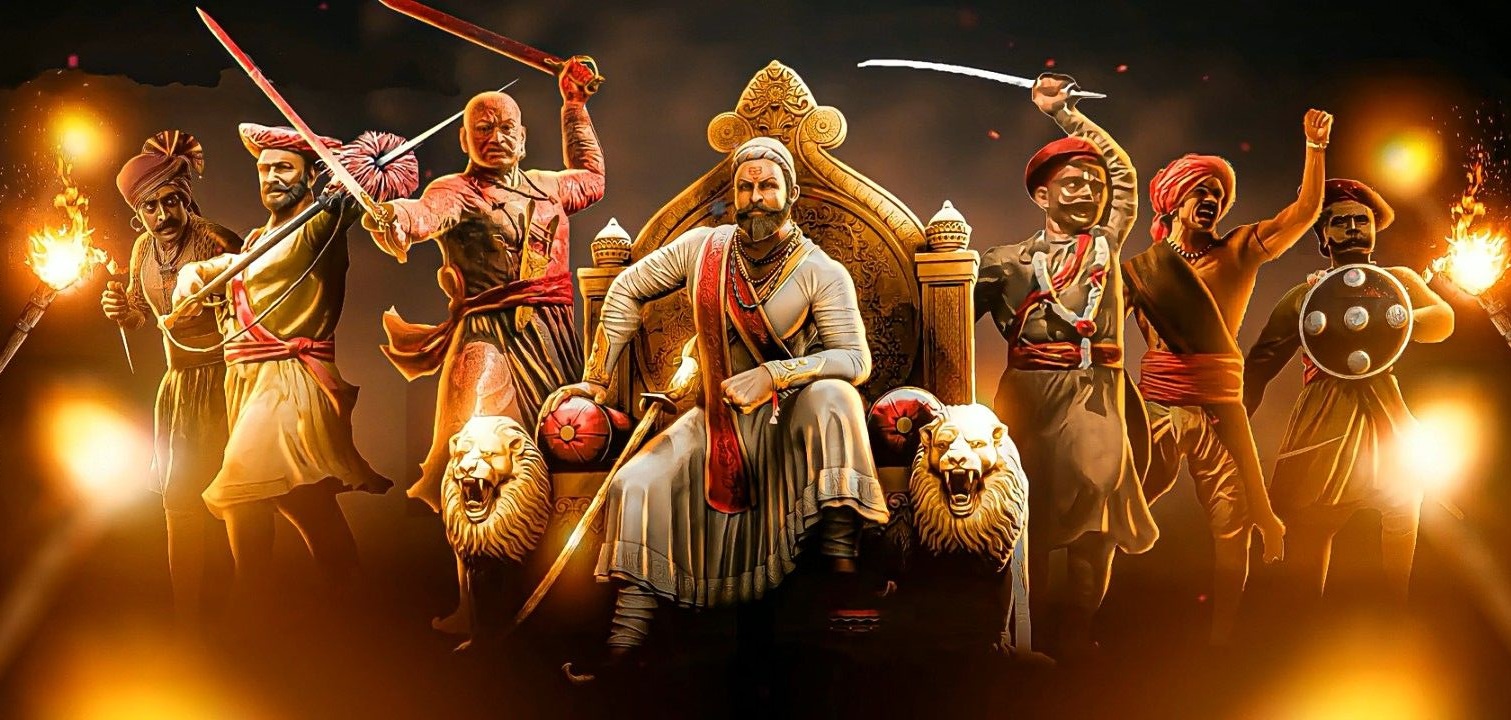
Chhatrapati Shivaji Maharaj: The Visionary Who Built the Maratha Empire
Shri Chatrapati Shivaji Maharaj was born in either April 1627 or February 19, 1630, at Shivneri Fort near present-day Pune in Maharashtra. He was the son of Shahaji Bhosale, a Maratha general who served the Deccan sultanates, and Jijabai, whose deep spiritual influence shaped his character and vision from an early age.
During Shivaji’s childhood, much of India was under Muslim rule. The Mughal Empire dominated the north, while the Deccan region was controlled by the sultanates of Bijapur and Golconda. Growing up amid political instability and religious tensions, Shivaji developed a strong resolve to establish self-rule, which he later described as Hindavi Swarajya—self-governance for the people of the land.
Rise Against the Deccan Sultanates
At just 16, Shivaji began capturing small forts from the Bijapur Sultanate. His early victories were marked by strategic planning, surprise attacks, and knowledge of difficult mountain terrain. In 1659, when the Bijapur general Afzal Khan marched against him with a large army, Shivaji used a combination of diplomacy and tactical brilliance to defeat him in a dramatic encounter.
This victory dramatically raised his stature, enabling him to capture more territory and strengthen his military resources.
Confrontation with the Mughals
Shivaji’s growing influence alarmed the Mughal emperor Aurangzeb. A series of clashes followed, including Shivaji’s daring raid on Surat, a wealthy Mughal port city.
In 1666, Shivaji was summoned to the Mughal court in Agra. There, he was placed under house arrest. Demonstrating remarkable courage and intelligence, he famously escaped by hiding in large baskets reportedly meant for sweets distribution. His return to the Deccan reinvigorated his followers and marked a turning point in his struggle.
Coronation and Establishment of the Maratha Empire
In 1674, Shivaji was formally crowned as Chhatrapati (sovereign ruler) at Raigad Fort. This coronation signified the official beginning of the Maratha Empire. He established a well-structured administrative system with a council of eight ministers known as the Ashta Pradhan.
Shivaji emphasized efficient revenue collection, promoted agriculture and trade, and developed one of the earliest modern naval forces in India to protect the western coastline from foreign powers, including the Portuguese and the English.
Religious Tolerance and Governance
Though deeply devoted to Hindu traditions, Shivaji practiced religious tolerance. He protected mosques and churches, employed Muslims in key positions, and opposed forced religious conversions. His policies focused on justice, security, and welfare rather than religious discrimination—an uncommon approach in a period marked by sectarian conflicts.
Final Years and Legacy
Shivaji passed away on April 3, 1680, at Raigad Fort. After his death, his son Sambhaji succeeded him, and despite internal and external challenges, the Maratha power expanded significantly in the 18th century.
The Maratha Empire continued to grow, eventually becoming the dominant force in much of India before its decline following the Anglo-Maratha Wars in 1818 against the British East India Company.
Historical Impact
Shivaji’s leadership revived confidence among the local population and introduced new military tactics, including guerrilla warfare. His fort network, naval defense strategy, and administrative reforms became hallmarks of Maratha governance.
Today, he is remembered not only as a warrior king but also as a visionary administrator and symbol of self-rule, courage, and resilience.
Chhatrapati Shivaji Maharaj’s life remains a powerful chapter in Indian history—an enduring story of strategy, statecraft, and the pursuit of sovereignty.